
Happy Pride Month 🌈 We have several research projects from our faculty and PhD students that focus on the LGBTQ+ population. Find out about some of them below:
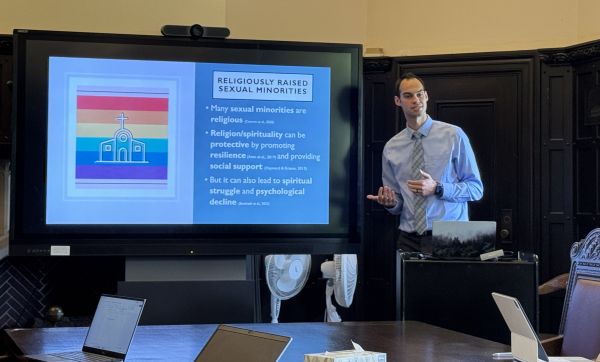 Andrew Moffitt, Clinical Psychology PhD student, has spent the last several years exploring the relationships that sexual minorities have with religion. In an online survey of Christian-raised sexual minority adults, he found that participants who perceive God as disapproving of same-gender relationships tend to experience greater struggles around whether these relationships are perceived as moral. Using this same sample, Drew found that participants who experienced spiritually harmful or abusive events reported worse mental health, including higher levels of depression, anxiety, internalized homonegativity, and lifetime spiritual struggles. In a meta-synthesis of the last 14 years of qualitative data on sexual orientation and religious identity conflict, Drew found that sexual minorities used a wide array of strategies to reconcile their identity conflict. Participants tried to reject a sexual orientation identity, reject a religious identity, compartmentalize their identities, or integrate their identities. Drew found some novel ways participants addressed their identity conflict, which included viewing their identities as fluid and multifaceted or avoiding identity labels altogether. Together, these studies uncover some of the unique ways in which sexual minorities navigate sometimes complex relationships with religion.
 Julianne Origlio, Clinical Psychology PhD student, focuses her research on studying mood and anxiety disorders among adolescents, particularly among LGBTQ+ youth. I am especially interested in stress-related and interpersonal factors as well as adapting psychotherapy treatment to meet the needs of this population. In a recent study completed as part of my master’s thesis, I examined how negative internalized perceptions of self in the context of interpersonal functioning relate to adverse mental health outcomes. This study included a national sample of over 100 LGBTQ+ youth aged 12-18 years. Findings from this study highlight the role of sexual and gender minority stress as well as interpersonal factors of thwarted belongingness, perceived burdensomeness, and loneliness in relation to outcomes of depression and anxiety. This study informs further research I plan to conduct by emphasizing the impact of interpersonal stress on LGBTQ+ youth and the need to adequately address this is treatment.
 Samantha Martin– Clinical Psychology PhD student, focuses research on the impact of adversity and processes of coping in parents, predominantly focusing on stress and resilience of LGBTQ+ parents facing discrimination. I am particularly interested in examining the natural and exceptional strengths of this population to inform the development of interventions and supports. In my master’s thesis, I examined how social support, dyadic coping, parental identity, and mental health outcomes interrelate within the context of a heterosexist environment to better understand processes of minority stress and resilience. This study included an international sample of 140 same-gender mothers. Consistent with previous research, this study highlighted dyadic coping as a particular strength for same-gender mothers. This coping between partners played a role in stronger parental identity commitment. I am extending this research through my dissertation, which evaluates the needs and preferences of same-gender mothers for dyadic-coping focused interventions. This informs my future research goals, which center on increasing access to LGBTQ+ culturally sensitive and affirming mental health interventions for children and families.
 Dr. Amy Przeworski, Ph.D– runs the SOAR Lab here at CWRU. I am interested in factors that contribute to the development and maintenance of anxiety disorders in children, adolescents and adults. These factors include interpersonal correlates of anxiety, cognitive factors, and behavioral factors. I also develop novel treatments for anxiety disorders. I mostly work with individuals with OCD, generalized anxiety disorder, social anxiety, and separation anxiety disorder.
I’m also interested in the experiences of minority individuals, including LGBTQ individuals and racial and ethnic minorities. Minority individuals often experience discrimination, an experience that is associated with increased stress and psychological symptoms. I am interested in what factors buffer the experience of discrimination in minority individuals and are associated with resilience and adaptive coping.
The studies that we do in the lab are designed to help improve the understanding of the development and treatment of stress and anxiety disorders as well as factors associated with adaptive coping with stressors. For more about the SOAR Lab, click here