
Elizabeth Short: Remembering Her Youth, Reflecting on Her Career, and Retiring With a Bang
Set to retire in August 2026, Short shares her wisdom by discussing her childhood and career as a faculty member at CWRU and a developmental and child clinical psychologist
By Haddy Dardir
Author’s Note: The interview for this article was conducted in February 2023. Some details may have changed since then.
Over the course of her academic career spanning nearly half a century, Elizabeth Short, PhD, has rarely failed to keep herself busy. Publishing a paper considered to be a breakthrough in positive psychology, collaborating with a major entertainment company to help create a children’s TV show, and pioneering a new master’s program in Case Western Reserve University’s Department of Psychological Sciences are only some examples of Short’s storied endeavors.
On the heels of retirement, Short is willing to pass the baton onto the next generation of developmental and child clinical psychologists, giving her students all they need to blossom in their own endeavors.
“Right now, instead of really being so focused on that kind of community-impact stuff, I’m working on the next generation of students who are being trained to give back to the community. Instead of being out there, I’m developing training programs for graduate students here in early intervention and making connections in the community in that way.”
In retrospect, Short’s experiences reinforce her status as a fully tenured professor who has been nominated for the title of distinguished university professor “at least four times.” Even with retirement on the horizon, however, Short has no plans of slowing down anytime soon.
“I think it’s time to try something new. And that means, as opposed to really spending as much time as I am in the classroom, to share my pearls of wisdom from both learning and experience … with agencies [and] with schools.”
Indeed, Short has pearls of wisdom to share far beyond the college classroom.
Falling in Love With Child Psychology
Since eighth grade, Short knew that she wanted to be a psychologist. She gained valuable perspectives on child development and health from growing
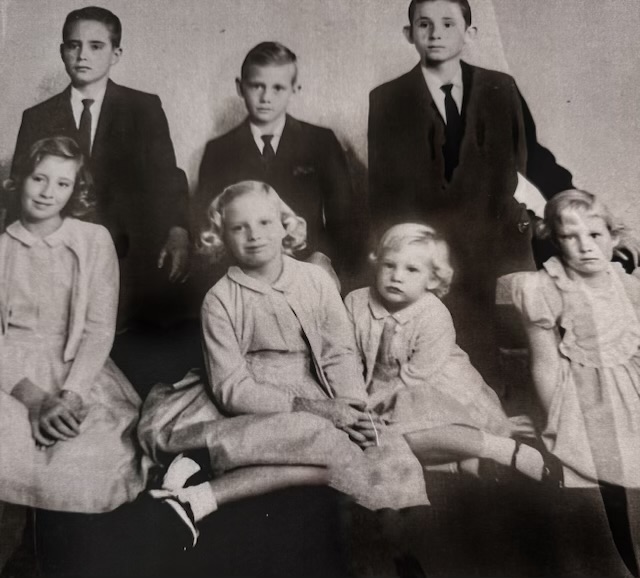
Short (middle left, front) pictured with her siblings Marianne (far left, front), Colleen (middle right, front), Carolyn (far right, front), Brian (left, back), Kevin (middle, back), and Bob (right, back) in the early ’60s
up the fifth of seven children who were all born a year apart. Her older brother who lived with undiagnosed autism for decades, Bob, was especially influential in her career trajectory.
Short’s mother took on the difficult task of raising seven children while being wrongfully labeled a cold, unreceptive “refrigerator mother” by some people because of Bob’s behavior. Also, Short’s father mandated that everyone in their house treat Bob “like everybody else” to accommodate his behavior at home.
“I watched the difference that my father made in my brother’s life. I don’t know if it’s because I heard him working with him every single day or … how my father celebrated individual differences in all of us while placing high expectations on everybody.”
On a more comedic note, Short describes how her father expected her to attend medical school to “be a real doctor” when she wanted to focus on doing research with children and families, to which he responded with something along the lines of, “I don’t get it. You wanna be a teacher?”
Even when Short’s father eventually supported her chosen career path, Short gained K-12 teaching experience in the middle of her first master’s program at Boston College anyway to keep herself busy. At 21, she taught eighth grade at an inner-city Catholic school in the middle of desegregation busing, in which the school served as an alternative for students who wanted to avoid being bused.
According to Short, the student body was diverse, with the majority of students being either African-American, Hispanic, Haitian, or Irish-Catholic minorities. Even so, Short offers a harrowing account of her first day. Within minutes of arriving, the only white student in her class was expelled for the minor offense of talking back, and she witnessed another teacher physically discipline an African-American student.
“I think I was pretty naive and pretty terrified, but I also thought, ‘This was an opportunity to do something very cool, so let’s get it done.’” As luck would have it, Short overcame the early troubles she had with her students and managed to lead what she thought was a good school year. She credits her father with her ability to program with kids, meet them where they are, and push them to excel.
Advocating for Lifelong Education
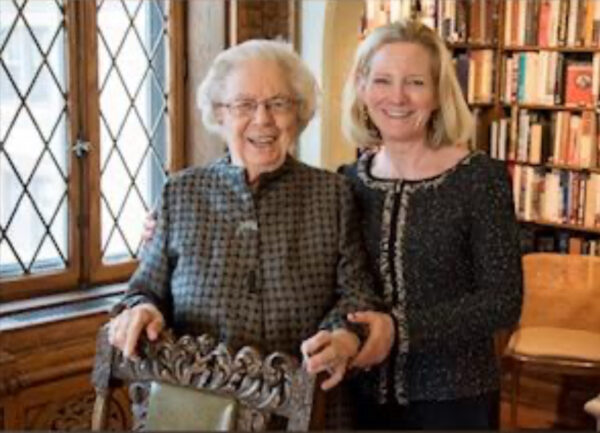
Short pictured with Jane Kessler, her former mentor and the founder of CWRU’s Mental Development Center. Short’s clinical training at CWRU was heavily influenced by Kessler’s guidance.
Short believes that knowledge is power. According to her, this belief is the reason she attended not only the University of Notre Dame to complete her bachelor’s in psychology (’76), a master’s in developmental psychology (’79), and her PhD in developmental psychology (’82), but Boston College to complete a master’s in counseling psychology (’78) as well. This belief is also something she hopes to impart to her students who are “trying to learn the delicate balance between knowledge acquisition, confidence, and humility.”
“I think what lots of education teaches us is that no matter how much we have learned and know, there’s a whole lot more that you don’t know. Being able to appreciate that, I think, is really important because it makes you keep asking questions and seeking out answers and reading. The power of knowledge acquisition comes from an ability to read, and we can’t hear everything, but we can read like crazy.”
Although Short is aware of the importance of building confidence in students and balancing this with humility, she also believes that ignorance will result when the scale is tipped in favor of confidence.
In 1981, Short started postdoctoral training at the University of North Carolina at Chapel Hill (UNC). While working in early intervention at the UNC Frank Porter Graham Child Development Institute, she realized that a clinical psychology education would give her a better point of entry in treating children’s affective problems.
“There was a lot I didn’t consider because I didn’t study the affective realm … of clinical psychology. I just thought [that] to have a more comprehensive picture of what happens when you repeatedly fail [and] what happens when somebody’s criticizing you all the time … I needed the clinical degree too. And I like school. School’s easy. School’s interesting. School keeps me on my toes.”
Despite obtaining a clinical psychology certificate from CWRU (’94) in addition to all of her degrees, Short has never seen an end to her education. Eager to learn new things, she regularly listens to audiobooks on her phone and has even considered pursuing economics and accounting degrees in her spare time.
Researching to Make a Difference
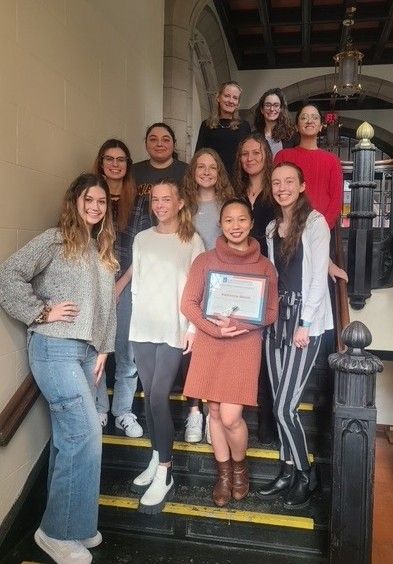
Short (back, far left) pictured with a handful of her CWRU students
In 2007, Short won the Keith Conners Award for best paper in ADHD. The paper, according to her, was pivotal in helping clinicians provide interventions for ADHD that minimized negative behaviors while maximizing positive behaviors.
“It’s all ‘they can’t, they can’t, they can’t, they can’t.’ Right? What this paper was all about was to describe not only what they couldn’t do but to [also] describe some of the aspects or strengths … these kids had and … by focusing so much on the deficits, we were actually suppressing the positive behaviors.”
One of Short’s most recent publications on the effects that the COVID-19 pandemic had on social-emotional learning in K-12 children is an example of how her scholarly rigor can work hand-in-hand with real-world applications. Collaborating with fellow CWRU psychologist Amy Przeworski, Short recounts how casual their conversations leading up to the study were, as much of the study’s motivation arose from Przeworski’s young children and the issues they faced in school because of the pandemic.
“Honestly, I think Amy and I were getting together over a glass of wine, talking about school experiences and how to advise people in school, and it came to be in that fashion.”
With retirement approaching, Short plans to publish additional findings from her Optimized Learning and Engagement With Young Families project soon. “There’ll be more. I intend to do about ten more [papers] before I retire. So I gotta get going ’cause I’m gonna retire soon.”
Venturing Beyond Academia
In the late ’90s, Short was hired by Warner Bros. as a developmental psychology expert who reviewed content related to the cartoon Baby Looney Tunes that included games, coloring books, and the cartoon itself. Her main task was to make sure all content was targeting the correct developmental window for the show’s young audience.
“I think I was brought in just to make sure that the content matched what kids were able to do at that moment in time, that there weren’t too many distractors on the page and that type of thing.”
While Short made significant contributions to Baby Looney Tunes and even worked with Mattel at one point, contributions beyond academia have been stigmatized by the scientific community in the past. At the time of Short’s involvement with Warner Bros., taking research findings and applying them to the real world was often viewed as unprofessional among university professors and a distraction to writing grants, publishing journal articles, and making scientific contributions. Because job opportunities for researchers in the real world were scarce at the time, Short asserts that she got involved in the production of Baby Looney Tunes “because it was fun.”
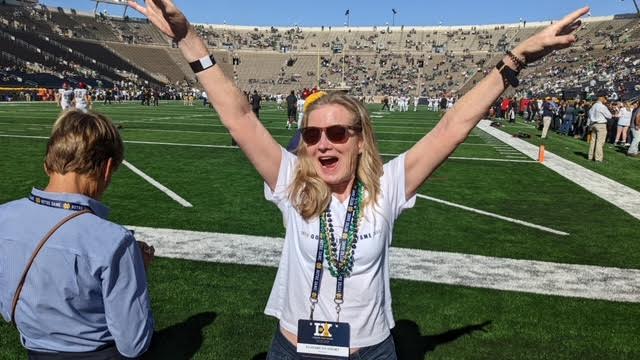
During her undergraduate years, Short was part of Notre Dame’s first class of women. She was honored as a pioneer of Irish women’s athletics at the university when she received the Monogram Award in October 2022
Although she admits that working in the real world from an academic background is viewed more favorably today, Short’s recent work has kept her busy with training her students. “It feels less about working with Mattel or Looney Tunes. It feels more like working with people like you or bringing in ten new graduate students every year so that they can go out and do this work.”
However, her more recent work with local school districts has given her a chance to spread her academic knowledge beyond a university setting. “When I go into an elementary school and I help design classrooms, or I address a problem a teacher is having with kids in her classroom, that’s me taking what I know and putting it in the real world. That’s me taking what I know and answering a ‘So what?’ question … to make something different.”
Giving Back to Society
Short kept a standalone freezer in her basement when her children were young. Similar to how an early interventionist accommodates a diverse group of children in their community, Short’s freezer accommodated a wide variety of ice cream flavors in her household.
“It’s individual differences. We’re all different. And that’s okay. We don’t want everybody to be vanilla. We want vanilla and we want chocolate and we want salted caramel and we want amaretto and I can give you all the ice cream flavors I like. We don’t all have to be vanilla.”
Keeping this in mind, Short already knows what her legacy at CWRU will be. “The development of this early intervention developmental master’s program at Case [Western Reserve] is a new program in this school. I developed a new certificate for the university. I developed a program that’s going to give back to the community.”